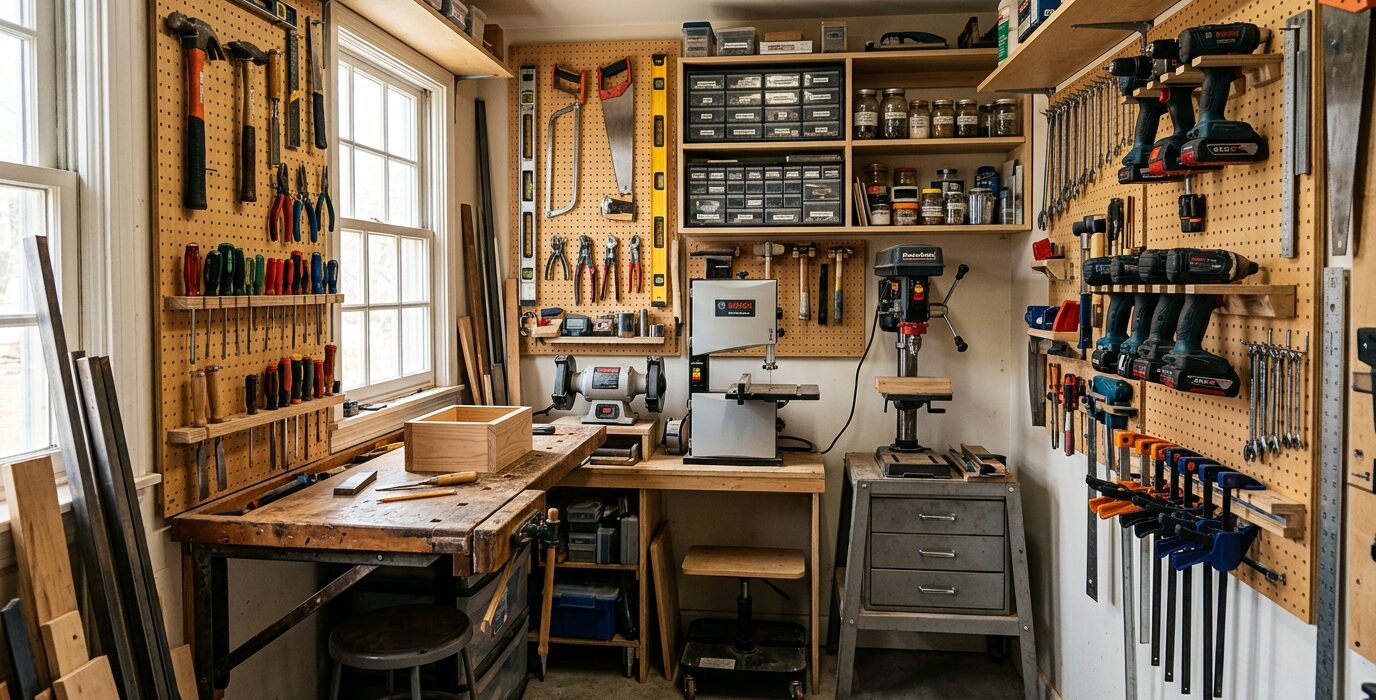
Maximize a Small Shop with Space-Saving Tool Combinations
In a small shop, tool selection is a purchasing decision, an organization decision, and a workflow decision simultaneously. Buying a benchtop planer that takes up permanent floor space in a 200-square-foot shop is a different decision than buying one for a 600-square-foot shop. These are the best tool combinations that deliver the most capability per square foot of floor space – either because they handle multiple functions or because they collapse when not in use.
The Track Saw + Straight Edge: Replaces a Full Table Saw
A track saw (Festool TS 55, Makita SP6000, Milwaukee M18 with guide rail) makes straight cuts in sheet goods as accurately as a table saw – and the track folds away. For a shop that primarily works with sheet goods (plywood furniture, cabinetry), the track saw approach frees up the 15+ square feet a table saw requires. Add a portable jobsite table saw for ripping solid lumber and you have full capacity in under 4 square feet of permanent floor space.
The Flip-Top Tool Stand: Two Benchtop Tools in One Footprint
A flip-top stand mounts two benchtop tools back-to-back on a rotating platform. Most common combinations: drill press + oscillating spindle sander, benchtop belt sander + disc sander, router table + bench planer. The stand occupies 20-24 square feet of floor space; two separate stands would need 40-48 square feet. Build time is one weekend.
The Moxon Vise: Bench Vise That Disappears
A Moxon twin-screw vise sits on top of the bench for use and stores on a shelf below it when done. It replaces a mounted face vise for most hand-tool operations and takes up no permanent space. For a shop where every inch of front-edge clearance matters, the Moxon is a smarter choice than a permanent vise for many applications.
The Compact Jointer + Planer Combo (Spiral Head)
The Hammer A3-26 and the Minimax FS30C are combination jointer-planer machines with spiral cutterheads. One machine handles both face jointing and thickness planing by switching modes. These machines cost more than separate units but occupy one floor footprint instead of two. For a shop where floor space costs more than money, they make excellent economic sense.
The Workbench as Outfeed Table
Position the workbench directly behind the table saw at matching height. The bench becomes the outfeed table for the saw during ripping operations. After ripping, roll the saw to the side and the bench is free again. This eliminates a dedicated outfeed table (typically 24×48 inches of permanent floor space) without any sacrifice in function.
FAQ
What’s the one tool combination that helps the most small shops?
A track saw replacing a full table saw for sheet goods work is the highest-impact space trade-off. If your projects are primarily sheet-goods based (plywood furniture, built-ins, cabinetry), a track saw plus a small miter saw handles 80% of cutting operations. The floor space reclaimed is transformative in a small shop.