No Power Tools Required: A Complete Hand Tool Shop
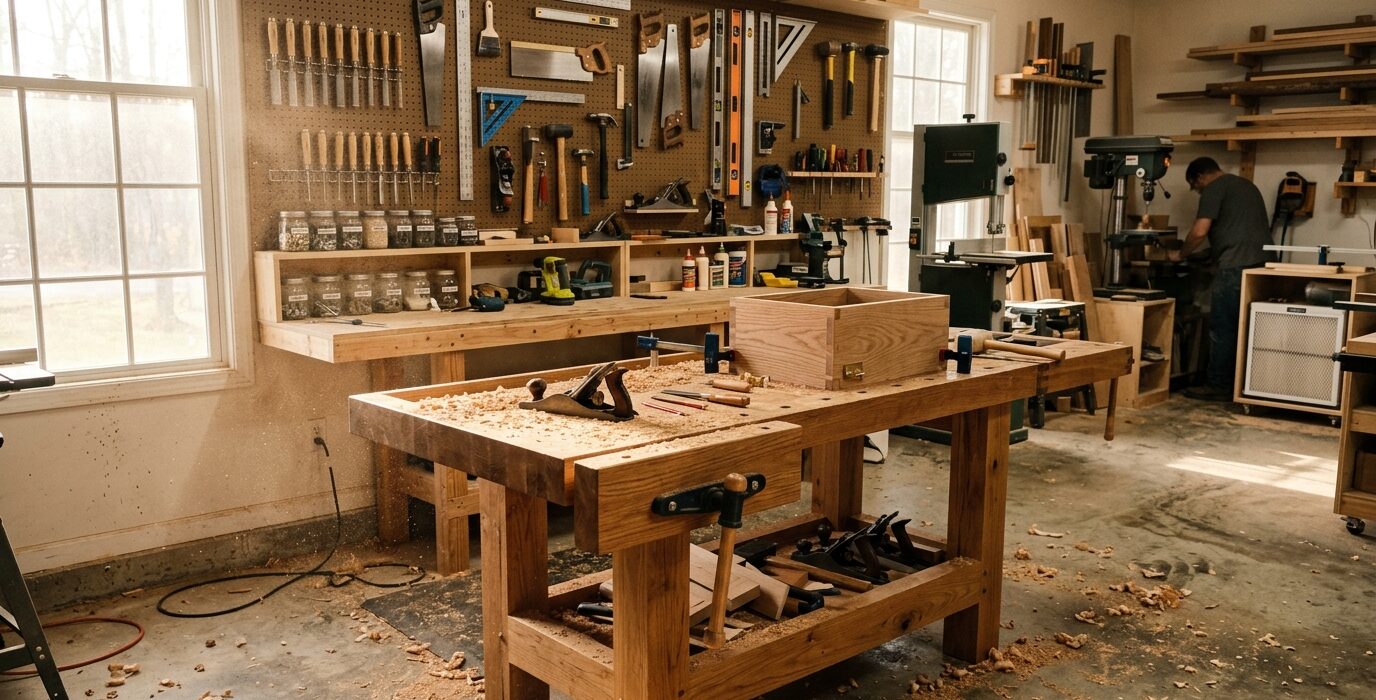
This shop tour covers a workshop that operates entirely without power tools – no table saw, no router, no electric sander. Every cut is by hand saw, every surface is planed, every joint is chopped. It’s a legitimate approach to woodworking with distinct advantages: whisper-quiet operation, no dust collection required, and the ability to operate in spaces where power tools wouldn’t be practical.
The Shop Space
A 12×14 garage that doubles as a woodworking shop and a storage area. The lack of power tools means no clearance needed around machines – the entire floor is available for assembly and material handling. No dedicated dust collection is needed; the fine shavings from hand planes clean up with a broom, and the bench top shavings are swept into a bucket for firestarter.
The Workbench
The bench is the most important piece of equipment in a hand-tool shop – far more important than in a power-tool shop where machines do most of the holding. This bench is a traditional English joiner’s bench: solid beech, 8 feet long, with a leg vise and a tail vise with bench dogs. The top is 3 inches thick and the bench weighs over 300 pounds – it does not move during planing.
The Tool Collection
Hand tools for this shop were acquired over 10 years from estate sales, flea markets, and specialty dealers. The collection includes:
- Eight Stanley Bailey planes from a No. 3 smoother to a No. 7 jointer
- Twelve chisels (three sets covering bench chisels, mortise chisels, and paring chisels)
- Five hand saws: a ripsaw, two crosscut saws (coarse and fine), a tenon saw, and a dovetail saw
- Marking and measuring tools: three squares, a sliding bevel, marking gauge, mortise gauge, dividers, and a wheel cutter
- Mallets: a joiner’s mallet and a carver’s mallet
- A sharpening station with three water stones (1000/4000/8000 grit) and a leather strop
Workflow in a Hand-Tool Shop
Material comes in as rough-sawn lumber. Dimensioning is sequential: saw to rough length with the handsaw, face-joint with the scrub plane, flatten with the jack plane, square with the jointer plane. Edge jointing uses the jointer plane against the side of the bench as a shooting board. It’s slower than machine dimensioning – typically 3-4 times – but the tactile feedback and precision are different in kind, not just degree.
The Advantages
- No dust collection required – hand tools produce shavings, not fine dust
- No noise issues – can work at any hour without disturbing neighbors
- No electricity required – portable, operates in any location
- Lower cost of entry – good hand tools cost less than equivalent power tools and last indefinitely with maintenance
FAQ
Is hand-tool woodworking slower?
For stock preparation (dimensioning rough lumber), yes – significantly. For joinery cutting (dovetails, mortise and tenon), a skilled hand-tool worker is competitive with machine methods. For finishing (smoothing, scraping), hand tools are often faster than sandpaper through progressively finer grits. The total time difference on a finished piece depends on the piece and the skill level; the work is not categorically “slower” – it’s just differently distributed across operations.