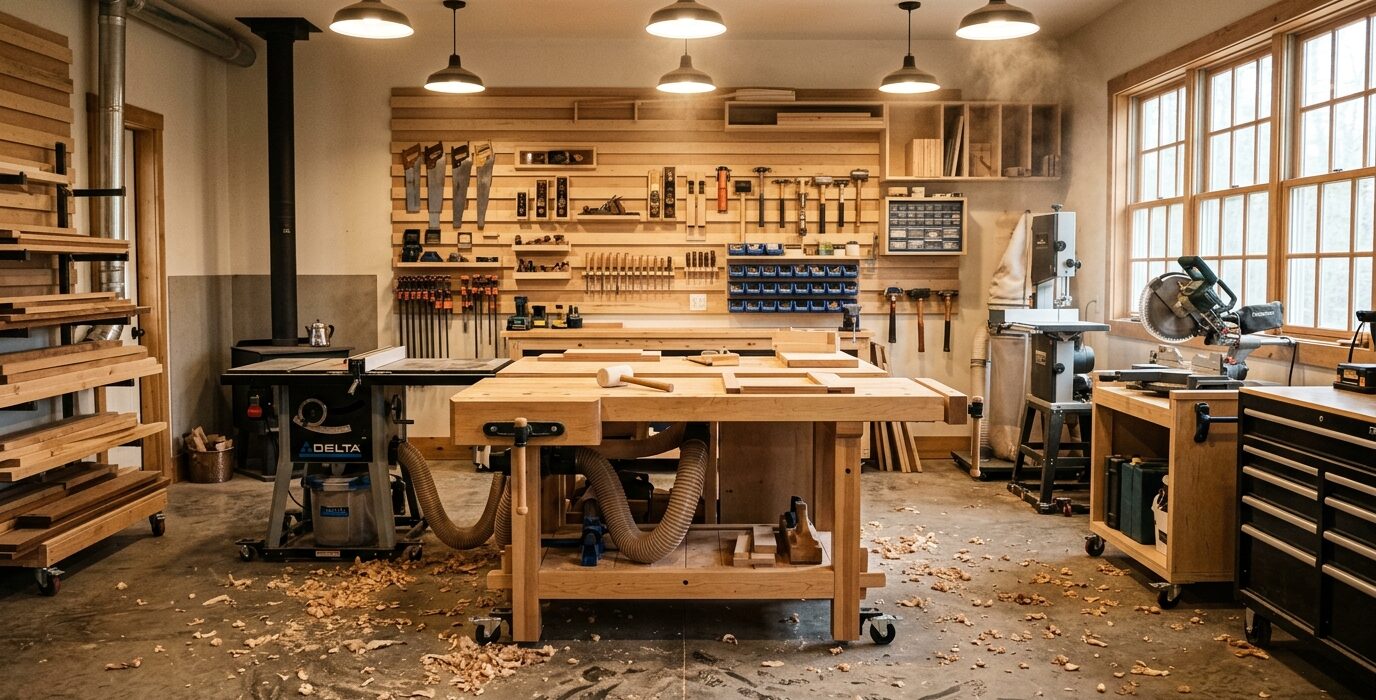
Everything on Wheels: The Mobile and Modular Shop
This shop tour is about a philosophy as much as a specific configuration: everything in the shop is on wheels, every storage unit is modular, and the entire shop can be reconfigured in under an hour. The owner, who has moved three times in ten years, built this system after losing two shops to relocation – now the shop goes wherever the owner goes.
The Mobile System
Every machine has a heavy-duty mobile base with locking casters. Every storage unit – tool cabinets, lumber racks, assembly tables – is freestanding on wheels. The only fixed elements in the shop are the electrical outlets, the overhead lighting, and the dust collection drop connections (which use quick-disconnect fittings). Everything else rolls.
The Modular Storage Units
Storage in this shop uses a standardized module: 24x24x36-inch rolling cabinets, all the same height and roughly the same footprint. The cabinets push together to form workstations or separate into individual units. When moving the shop, each cabinet is a single, manageable unit that fits through a standard doorway and fits in a pickup truck.
The Current Configuration
In the current 22×24-foot garage, the shop runs in two primary configurations:
- Milling configuration: Table saw centered in the space with full infeed/outfeed clearance, jointer and planer to the side in processing position
- Assembly configuration: Table saw and planer pushed to the perimeter walls, assembly table centered, workbench adjacent
Switching between configurations takes 15-20 minutes.
The Benefits of Full Mobility
- Shop moves with the owner – three times in ten years with minimal disruption
- Single-machine floor clearance – every machine gets full clearance when needed, no permanent compromises
- Deep cleaning – the entire shop floor can be cleaned in an hour because everything rolls away from the walls
- Reconfigurable for project needs – large panel glue-ups get maximum floor space; detailed bench work keeps the floor compact
What Full Mobility Costs
Mobile bases add cost and height to every machine. Heavy-duty casters rated for 600-pound loads cost $15-$30 each – times four casters times ten machines adds up. Each machine sits 4-6 inches higher than floor level due to the caster height – ergonomic implications for some operations. And every machine needs its floor lock engaged before any cut – a discipline that becomes automatic but requires attention initially.
FAQ
Does a mobile shop compromise accuracy?
Not if casters are locked properly before each use. A table saw with two locking swivel casters and two rigid casters, all locked, is as rigid as a bolted-to-the-floor installation for practical woodworking purposes. The only operation where the table saw position matters is the table saw fence calibration – which needs to be verified whenever the saw moves to a new position anyway.