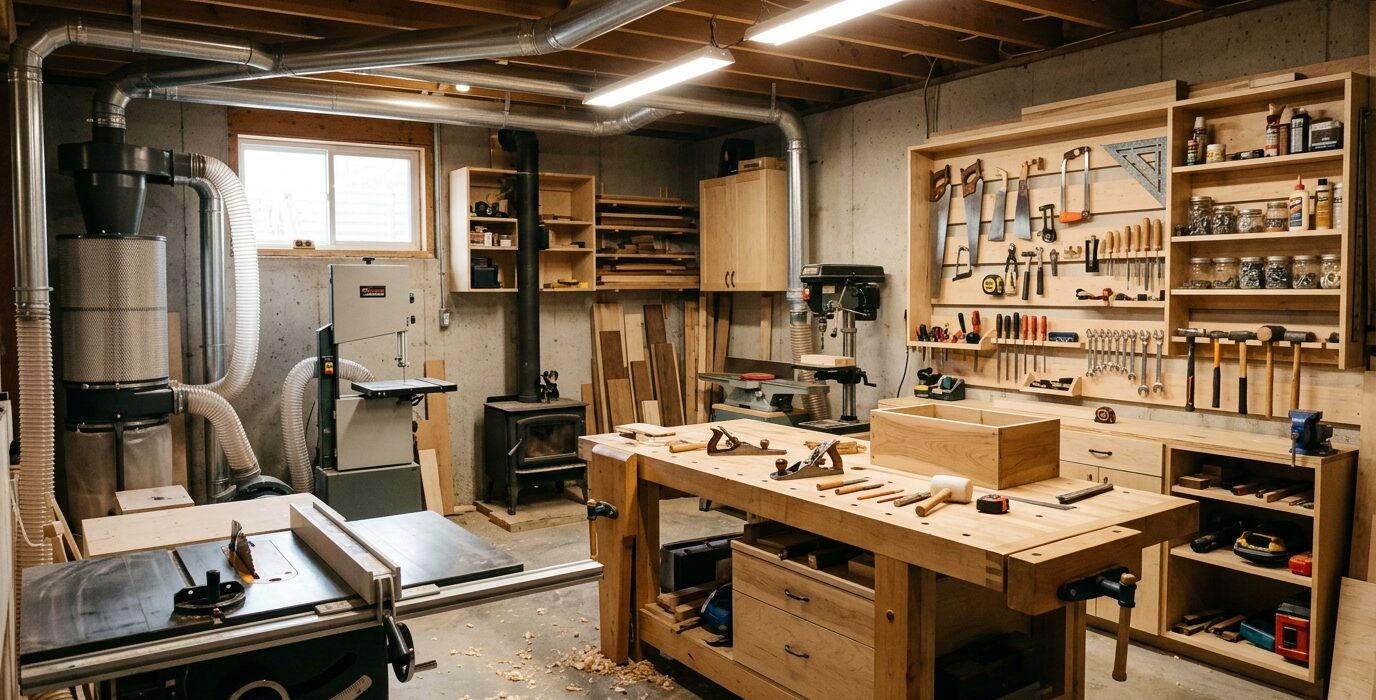
Basement Workshop with Full Dust Collection
This tour covers a basement workshop that took three years to build out and one year to get the dust collection truly right. The basement advantage is climate control and significant square footage; the challenge is the tight ceiling height (7 feet 2 inches at the beam), the dust isolation requirement, and the sound management needed for a family living directly above the shop.
The Space
The shop occupies 300 square feet of a 1,200-square-foot basement, separated from the living area by a stud wall with 1/2-inch drywall and rockwool insulation. The separation wall has a solid-core door (critical for sound management) and a dedicated exhaust fan that creates negative pressure in the shop – dust flows toward the exhaust, not toward the living space.
The Dust Collection System
This is the most engineered element in the shop. A 3 HP Oneida Professional cyclone sits in the corner on a wheeled cart. Four-inch main duct runs along the ceiling, with drops to four machine positions: table saw, jointer, planer, and router table. Each drop has a manual blast gate. The table saw uses a purpose-built splitter/guard with an overhead dust chute in addition to the under-table connection – the only way to capture table saw dust adequately.
Sound Management
The table saw (a SawStop) is the loudest machine in the shop. Anti-vibration isolation pads under the mobile base reduced the structure-borne transmission to the floor above significantly. The rockwool-insulated partition wall handles airborne sound. Neither fix is perfect – a table saw in the basement is audible upstairs, but it’s no longer disruptive enough to end conversations or interfere with TV at normal volume.
What the Low Ceiling Changes
At 7 feet 2 inches, the ceiling is tight enough that long boards need careful management when carried vertically. Panel lifting for the table saw requires horizontal carries at all times. The ceiling joists are a storage resource: lumber is stored horizontally on ceiling-mounted brackets between the joists. Short stock (under 8 feet) stores fine; 10-foot boards need specific routing to fit.
FAQ
Is a basement shop worth the extra complexity?
For a homeowner with an otherwise-unusable basement, absolutely. The temperature-controlled environment extends the working season to year-round without the heating costs of a detached garage. The sound isolation, dust management, and egress requirements add complexity and cost, but the result is a dedicated, stable shop environment that protects both tools and the home.