Two Traditions, One Shop
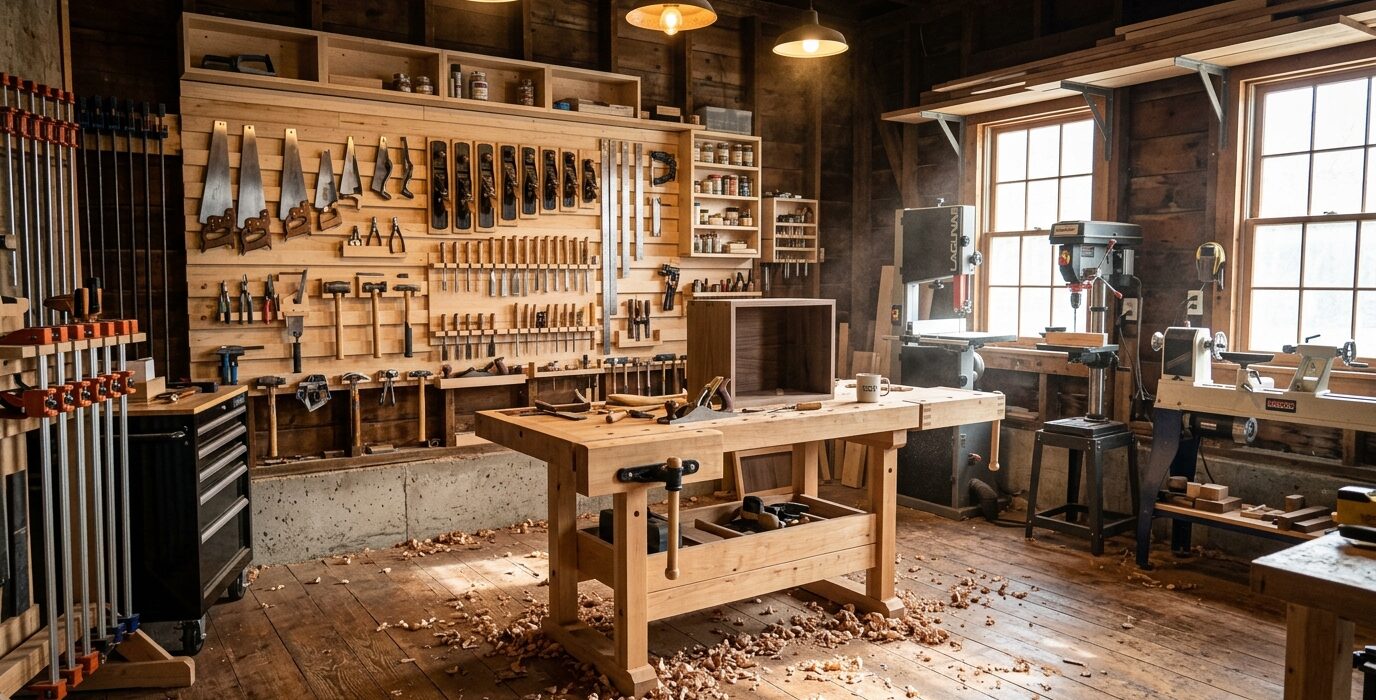
The hybrid shop blends hand tools and power tools in a way that gets the best from each. Power tools handle stock preparation – dimensioning, rough cuts, jointing. Hand tools handle fitting, final surfacing, and joinery. The result is faster than pure hand-tool work and more refined than pure power-tool work. This tour covers a 400-square-foot hybrid shop that’s been refined over eight years to support exactly this kind of workflow.
The Power Tool Zone
One half of the shop is organized around the table saw, which is the centerpiece of almost every project. A contractor-style saw sits in the middle of this zone with 4 feet of outfeed room and 6 feet of rip capacity to the right. A miter saw station runs along the back wall with 12-foot support wings that handle long stock. The drill press and band saw occupy the corners. Dust collection ties everything together with a 1.5-horsepower single-stage collector and flexible hoses to each machine.
The Hand Tool Zone
The other half of the shop is built around a heavy Roubo-style workbench with a leg vise on the left and a shoulder vise on the right. The bench is 36 inches wide and 7 feet long – enough to support a full cabinet side while hand planing. A dedicated tool wall runs behind the bench: hand planes on a till, chisels on a rack, saws hanging on a French cleat panel. Everything needed for fine fitting is within arm’s reach of the bench.
The Workflow
A typical project starts in the power tool zone: rough lumber goes through the jointer, planer, and table saw to become dimensioned stock. That stock moves to the hand tool zone for layout, chopping mortises, fitting tenons, and final surface preparation before finishing. The two zones rarely compete for space because the operations happen at different stages of the project. When one zone is busy, the other is usually idle.
Sharpening Integration
The sharpening station lives at the end of the hand tool bench – a small rolling cabinet with a slow-speed grinder, waterstones in a trough, and a leather strop. The owner sharpens whenever a tool needs it, which in hand-tool work is constantly. Having sharpening built into the bench rather than in a separate location means it happens automatically, not when the owner finally decides it’s worth the walk across the shop.
Lighting
The hand tool zone has better lighting than the power tool zone – intentionally. Hand planing and fitting require seeing grain direction, reading surfaces in raking light, and catching imperfections before assembly. The bench has a dedicated task light on a flexible arm that can be aimed at any angle. The power tool zone has general overhead lighting that’s bright enough for safe machine operation but doesn’t need to reveal surface subtleties.
Key Lessons
- The two-zone concept is the most important organizational principle in this shop. Separating rough power tool work from refined hand tool work keeps each zone set up optimally for its purpose.
- The heavy bench is foundational. A light bench that moves under hand planing pressure cancels out much of the advantage of using hand tools. Mass is a feature, not just a consequence of construction.
- Hybrid work actually makes both tool types more enjoyable. Power tools are less frustrating when you’re not trying to get them to produce hand-tool quality results. Hand tools are less tedious when you’re not starting from rough lumber every time.
FAQ
Where do I start building a hybrid shop?
Start with the power tool zone – a table saw and miter saw handle the most common dimensioning tasks. Then add a solid workbench and a basic hand tool kit. The hand tools can be acquired gradually; the bench is worth building right from the beginning because it serves every hand-tool operation.
What hand tools are essential for a hybrid shop?
A set of bench chisels in four or five sizes, a block plane, a No. 4 smoothing plane, a No. 7 jointing plane, a marking gauge, and a good dovetail saw. These tools handle 80 percent of what hand tools do better than power tools.