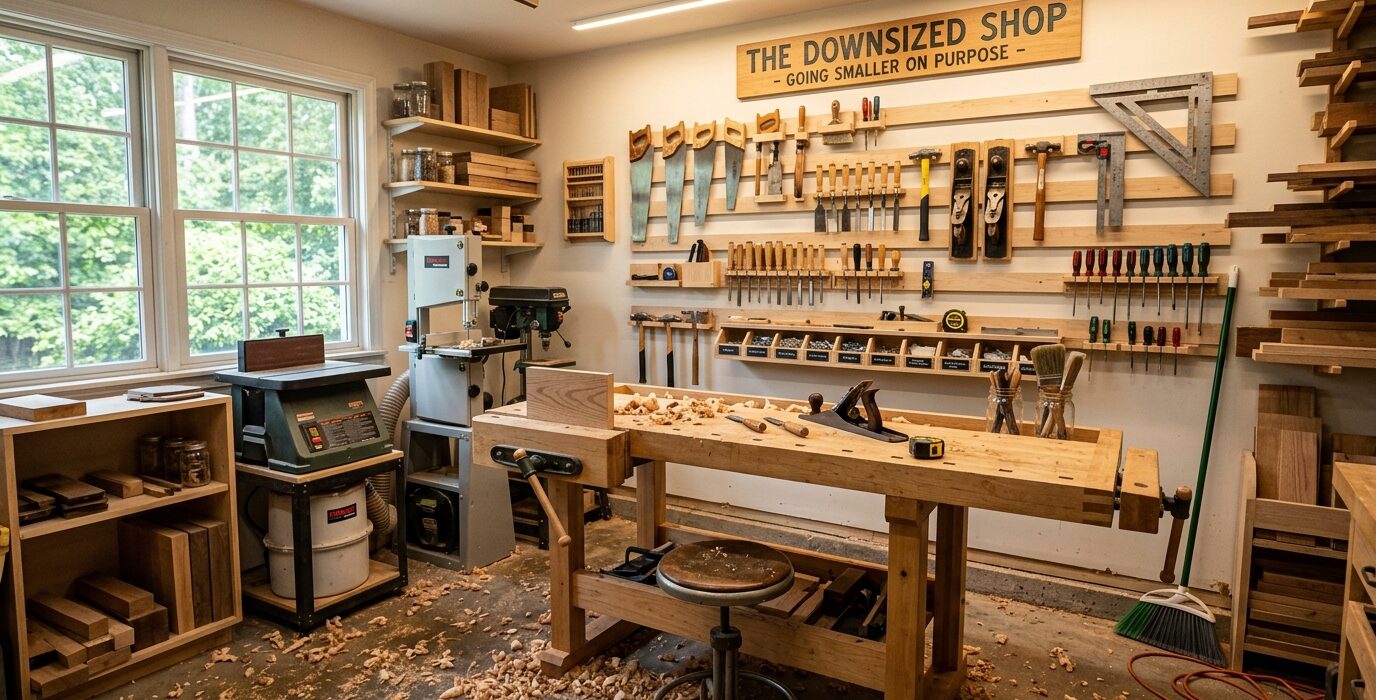
Smaller Space, Sharper Focus
This shop downsized from a 3-car garage to a 10-by-20-foot single-car space when the owner moved – and the forced constraints turned out to produce a better-organized, more efficient shop than the sprawling original. When space is limited, every tool earns its place, every surface has a purpose, and the workflow gets tighter. This tour shows how a full range of woodworking is possible in 200 square feet when the layout is planned with discipline.
What Stayed, What Left
The downsizing meant hard choices. The 10-inch cabinet saw got replaced with a compact jobsite saw that delivers 90 percent of the performance in a fraction of the floor space. The floor-standing drill press became a benchtop model. The 6-inch jointer stayed because no good substitute exists for face jointing. The 13-inch lunchbox planer replaced the 15-inch stationary planer. The band saw stayed – it’s too useful for resawing and curved cuts to give up. The result: a fully functional shop in less than half the space.
Layout Strategy
The layout uses a U-shaped workflow around three walls. The miter saw station anchors one short wall. The workbench runs along the long wall. The table saw sits in the center of the open floor with rolling outfeed support that folds away when not in use. The jointer and planer share a rolling base and roll to position when needed, then return to their corner. Nothing is permanent except the bench and miter station – everything else adjusts for the project at hand.
Wall Storage
Every wall that isn’t occupied by a machine carries storage. French cleat panels cover the wall behind the workbench from floor to ceiling. Tool holders, shelf brackets, small parts bins – all on cleats, all rearrangeable. The miter station has a full-width cabinet above it for router bits, jig hardware, and frequently used accessories. The space under the bench has two rows of pull-out bins for sandpaper, hardware, and finish supplies.
Key Lessons from Downsizing
- Every tool you own takes up mental space as well as physical space. Fewer tools, better chosen, make a shop easier to work in.
- Rolling tool bases are not optional in a small shop. If you can’t move machines around, you can’t use the space efficiently.
- The downsizing forced the owner to think about what he was actually building. He was mostly building boxes, small cabinets, and frames. The compact setup handles all of it perfectly.
FAQ
What tools are non-negotiable for a downsized shop?
Depends on what you build. For most furniture work: a table saw, a miter saw, a band saw, and a workbench. Everything else is secondary. Jointer and planer matter if you buy rough lumber; if you buy pre-dimensioned, you can skip them.
How do you handle sheet goods in a small shop?
Have them cut at the store or use a track saw. A 4×8 sheet of plywood requires at least 8 feet of clear space on all sides of the table saw to handle safely. In a 10×20 shop, that’s not realistic. A track saw on a folding table handles sheet goods in a fraction of the floor space.