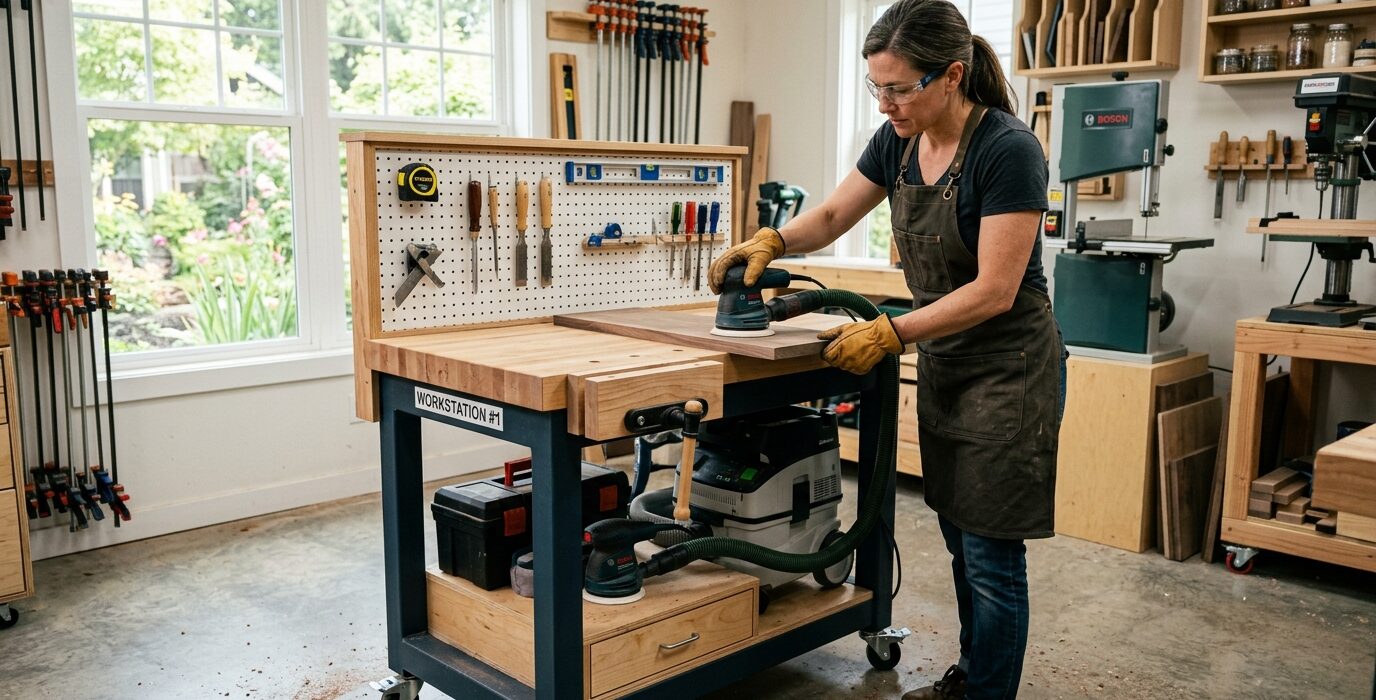
Work With a Mobile Shop Cart – A Workshop That Moves With You
The mobile shop cart is a different philosophy than a fixed workshop. Instead of setting up a permanent space and bringing work to it, the mobile cart brings the tools to the work. This approach is ideal for people who work in multiple locations – the garage one day, the driveway the next, a job site on weekends. It’s also the right answer for very small fixed shops where no single configuration of stationary tools works for all projects. This guide covers how to build and use a well-designed mobile shop cart.
What Goes on the Cart
The cart should hold the tools you reach for most in any session: a drill/driver, a jigsaw or circular saw, a sander, measuring tools, layout tools, and a selection of clamps. The work surface on top of the cart provides a raised platform for assembly and hand-tool work. The shelves below hold materials and larger tools. The cart becomes a self-contained workspace that can be wheeled to wherever the project is happening.
Building the Cart
A good mobile shop cart is roughly 24 by 36 inches in plan, 36 to 38 inches tall (bench height), with a 3/4-inch plywood work surface, a lower shelf 12 to 14 inches off the floor, and four heavy-duty locking casters rated for at least 150 pounds each. The frame is 2×4 construction with plywood sides. Add a drawer for small tools (measuring tape, pencils, square, utility knife) and a series of hooks on one side for cords and hoses.
Outfitting the Top
The work surface should be sturdy and flat. A double layer of 3/4-inch plywood, glued and screwed, produces a 1.5-inch thick top that doesn’t flex under load. Dog holes drilled through the top at 4-inch intervals give you positions for holdfasts, dogs, and bench stop accessories. A strip of 3/4-inch hardwood at the front edge adds rigidity and gives you a place to clamp boards for edge work.
Using the Cart Effectively
The cart works best when you treat it as a system. Before starting a project, load the cart with everything you’ll need for that work session. Roll it to the location. Set the locking casters. Work. When done, return everything to its position on the cart. This “load and deploy” workflow keeps the cart organized and ready for the next session without having to hunt for tools scattered across a fixed shop.
Pro Tips
- A power strip mounted on the side of the cart with a 20-foot extension cord means you only need one outlet connection no matter where you work.
- Label every storage location on the cart. When you’re on a job site and need to find a tool quickly, knowing exactly where it lives is the difference between smooth work and frustration.
- Add a top-mounted vise or bench vise to the cart’s front face. A Record-style woodworking vise or a simple machinist’s vise gives you a clamping station wherever the cart goes.
FAQ
What casters work best for a shop cart?
Polyurethane casters with locking mechanisms, rated for at least 150 pounds each (600 pounds total for a four-caster cart). Polyurethane rolls smoothly on concrete, doesn’t mark floors, and holds up under heavy loads. Avoid rubber casters for heavy carts – they flatten under load and become stiff over time.
How do I keep the cart from moving during work?
Lock all four casters before starting any operation that involves force against the work surface. Even with locking casters, position the cart so it can brace against a wall or bench during heavy operations like chopping or prying.