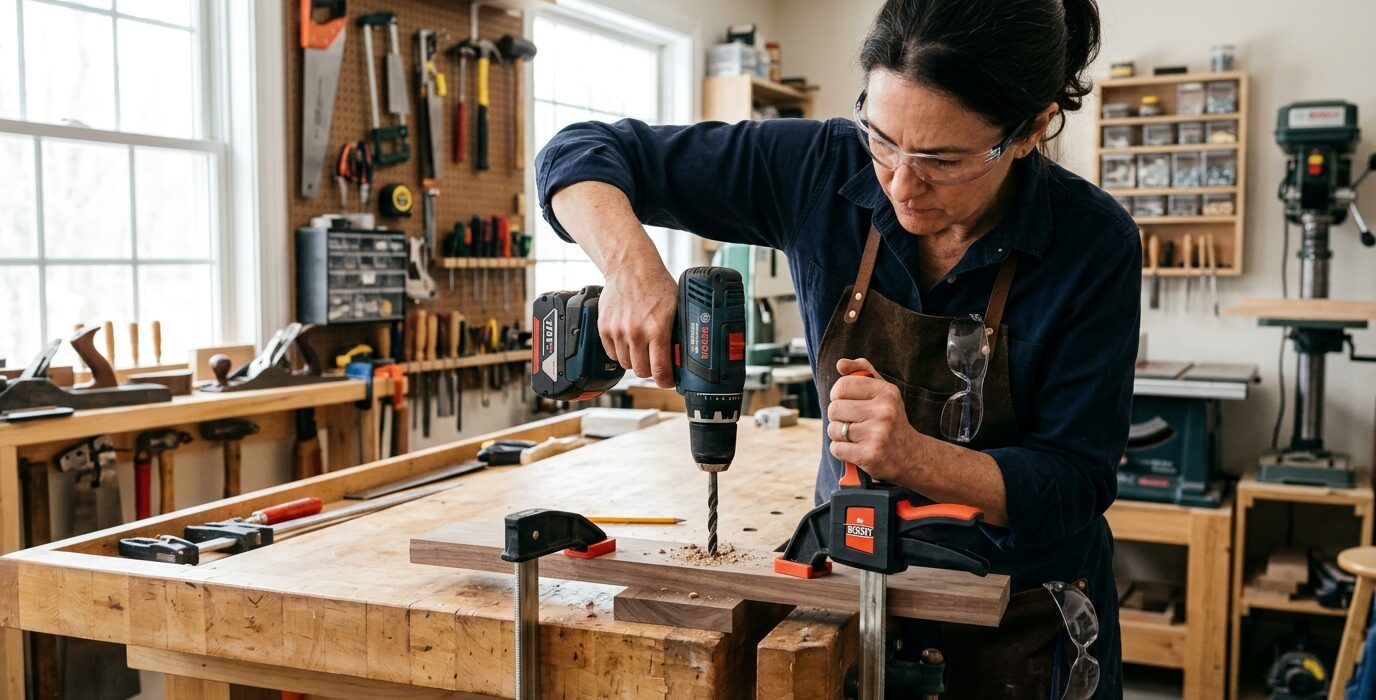
How to Prevent Workpiece Movement During Every Operation
A workpiece that moves while you’re cutting it is a workpiece being ruined – or a injury waiting to happen. The goal of workholding is simple: keep the material exactly where you put it, without your hands anywhere near the cutting edge, for the full duration of every cut. This guide covers the full toolkit of workholding solutions – from the bench dog to the featherboard to the toggle clamp – so you can match the right solution to every situation.
The Fundamental Principle
There are only two forces you’re trying to resist: forces that push the work out of position (lateral movement) and forces that lift it off the surface (uplift). A featherboard resists lateral movement against a fence. Hold-downs resist uplift on a router table. A bench dog resists lateral movement during hand planing. Understand which force you’re dealing with, and the right workholding solution becomes obvious.
Bench Workholding
On the workbench, the vise is the primary tool – but not for everything. For face planing, the work lies flat on the bench with a bench stop or dog at the far end to resist the forward push of the plane. The bench’s own mass provides the downward force that keeps the work on the surface. For edge jointing with a hand plane, the vise holds the board on its edge and you plane top-to-bottom. For chopping with a mallet and chisel, the bench’s mass absorbs the force – but you still need the work clamped or braced so it can’t shift laterally during each blow.
Table Saw Workholding
The fence and miter gauge are the fundamental table saw workholding tools, but they have limitations. A featherboard mounted to the fence keeps the board pressed flat against the table and tight against the fence through the entire cut – even when your hand has moved past the blade. A push stick keeps your hand away from the blade for the last 6 inches of a rip cut. A crosscut sled is safer and more accurate than a miter gauge for all crosscuts because it captures both sides of the cut and supports the full width of the panel.
Router Table Workholding
Featherboards are essential at the router table – one above the table surface to resist uplift, one against the fence to resist lateral movement. Both should be positioned so their pressure zone is before the bit, not at the bit or after it. A starting pin (a steel pin mounted in the table ahead of the bit) gives you a pivot point for freehand routing with a bearing-guided bit – you start the cut against the pin before engaging the bearing.
Toggle Clamps for Jigs
Toggle clamps are the workholding solution for repetitive operations. They hold a workpiece in a fixed position and release with a single motion, allowing you to cycle through multiple identical cuts without repositioning clamps. For a crosscut sled with a stop block, a pair of toggle clamps holds the workpiece against the stop block and the sled’s fence simultaneously. The cut is made, the toggle releases, the next piece goes in. Twenty identical pieces in 5 minutes without any movement variation.
Pro Tips
- Never start a cut without the workpiece fully secured. The moment “I’ll just hold it” enters your mind is the most dangerous moment in any shop operation.
- Test workholding before turning on the machine. Push the piece in every direction it could move during the cut. If it can move, it will – just at the worst possible moment.
- Build dedicated workholding into your jigs. A well-designed jig has the workholding built in, not added as an afterthought.
FAQ
Can I use my hand instead of a featherboard?
Against a fence, never. On the table and away from the blade, sometimes – but a featherboard does a more consistent job and your hand is free for the push stick. Replace hands with featherboards wherever possible and keep hands away from blades.
What’s the single most important workholding tool in a shop?
Clamps – more than anything else. The ability to clamp a workpiece to a bench, to a jig, to a fence, or to another piece of work is the foundation of everything else. Buy more clamps than you think you need, in more sizes than you think you’ll use.