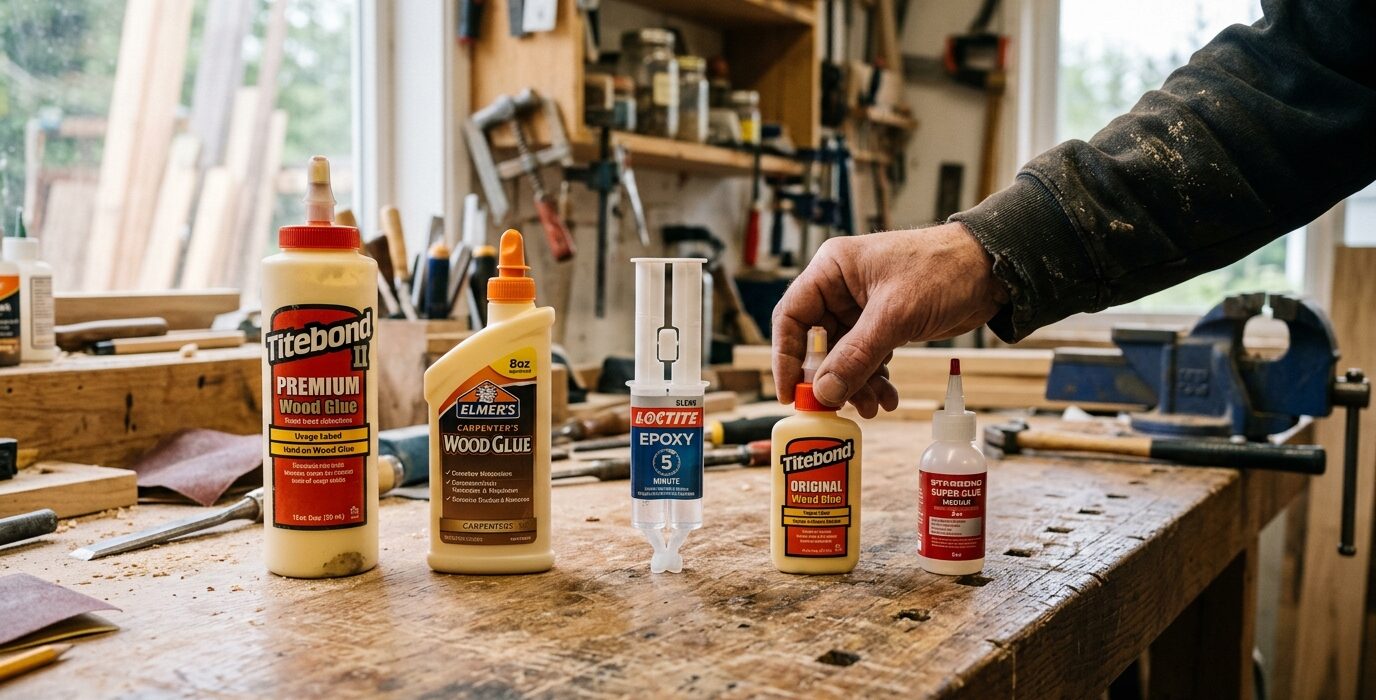
PVA, Epoxy, CA, and When to Use Each
Wood glue selection matters more than most beginner woodworkers realize. The wrong adhesive for the application doesn’t just fail – it can fail years later, after the project is in use, which is far more damaging than it never working at all. Understanding the three main wood adhesive categories and their specific applications lets you choose correctly every time.
PVA Glue (Yellow and White Glue)
PVA (polyvinyl acetate) is the standard woodworking glue – Titebond Original, Titebond II, and Titebond III are the most common. It bonds wood to wood with joint strength exceeding the wood itself. It’s water-based, easy to clean up when wet, and sandable. Open time is typically 5-10 minutes (Titebond I), 8-12 minutes (Titebond II), or 12-15 minutes (Titebond III).
Use PVA for: all standard wood-to-wood joints (mortise and tenon, dovetails, edge glue-ups), where you need sanding and workability. Limitations: water-sensitive (Titebond I is not waterproof), low heat resistance (softens above 130F), requires clamping for full cure.
Epoxy
Two-part epoxy bonds to almost any substrate, fills gaps, and is fully waterproof and heat-resistant. In woodworking, epoxy excels at: filling voids and knots, bonding end grain (which PVA bonds poorly), attaching hardware in stripped holes, and laminating materials where one substrate is not wood (glass, metal inserts). Slow-cure epoxies (West System, System Three) give more working time and are stronger than fast-cure types.
Limitations: expensive relative to PVA, messy to mix and apply, typically not sandable until fully cured (12-24 hours for slow-cure), and not suitable as a substitute for tight-joint structural glue in fine furniture because it requires a gap to function properly.
CA Glue (Cyanoacrylate / Super Glue)
CA glue bonds in seconds without clamping, making it invaluable for specific applications: temporarily holding jigs in position, repairing splits and cracks in turning blanks while at the lathe, tacking small pieces in place before driving screws, and bonding small parts that can’t be clamped. With the accelerator spray, it cures in under a second.
Limitations: brittle when cured (impact resistance is poor), not waterproof, and the bond line is not sandable – CA fills the joint and the excess must be scraped. CA is not a substitute for PVA in structural joints.
Choosing the Right Adhesive
- Furniture joinery (mortise and tenon, dovetails): Titebond Original or Titebond II
- Outdoor furniture, boat building: Titebond III or epoxy
- Void filling, epoxy river tables: Casting epoxy (System Three, MAS)
- End grain bonding: Epoxy or PVA applied twice (first coat as a sizing coat)
- Quick tacking, repairs: CA glue with accelerator
FAQ
Can I mix different glue types in one joint?
Don’t. Different adhesives cure at different rates and have different flexibilities when cured. A joint with mixed adhesive will have inconsistent stress distribution. Choose one adhesive per joint and apply it consistently. The exception is using CA to hold pieces in position while PVA cures elsewhere in the assembly – as long as the CA and PVA zones don’t overlap.