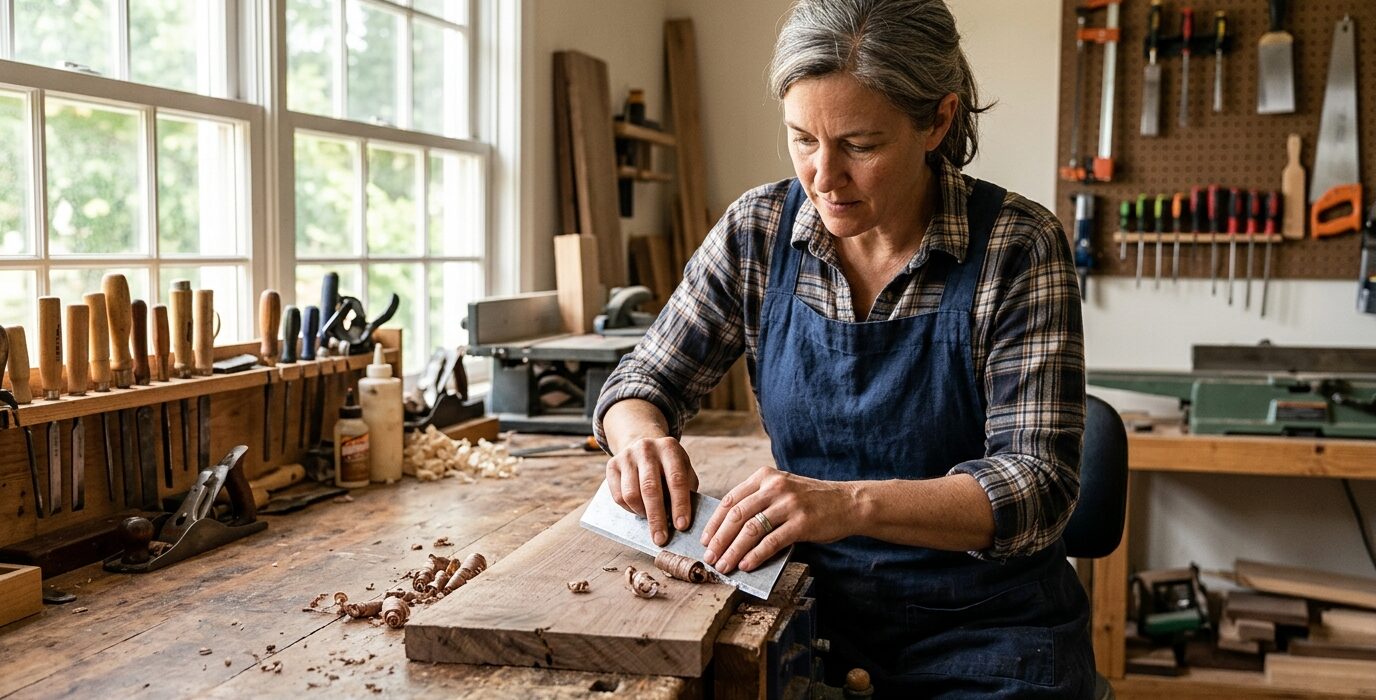
How to Use Hand Scrapers
The hand scraper is the most misunderstood tool in woodworking. It looks like a piece of sheet metal and in the hands of someone who doesn’t know how to prepare it, it is. But a properly prepared scraper with a burnished hook on the edge produces paper-thin shavings from any wood surface – including figured wood that tears out under any other tool – leaving a surface so smooth it requires no sandpaper before finishing. Learning to prepare and use a hand scraper is one of the highest-leverage skill investments you can make.
What the Scraper Does
The scraper’s cutting action comes from a tiny hook burnished onto the edge – so small it’s nearly invisible but very real. When the scraper is held at a slight angle and pushed or pulled across the wood surface, this hook slices off a thin shaving. Unlike a plane, the scraper can work in any grain direction without tearout, making it ideal for figured wood, difficult end grain areas, and glue line leveling.
Preparing the Scraper
A freshly bought scraper, or a dull one, needs to be prepared in three steps:
- File the edges flat: Clamp the scraper in a vise and draw a mill bastard file across the long edge until the edge is straight and square. File both long edges.
- Hone on a stone: Hold the scraper flat on your sharpening stone and hone the face on each side near the edge. Then hold the scraper vertical and hone each edge on the stone. The goal is a perfectly square, burr-free edge.
- Turn the hook: This is the essential step. Lay the scraper on the bench and rub a burnisher (a hard steel rod, a drill blank, or the back of a chisel) along the edge at a 5 to 10-degree angle, pressing firmly. Make 3 to 5 strokes. Flip the scraper and repeat on the other face. Feel the edge – you should feel a tiny, smooth hook.
Using the Scraper
Hold the scraper with both hands, thumbs behind and fingers in front. Bow the scraper slightly by pressing the thumbs behind the center. Apply this bowed scraper at a 10 to 20-degree angle to the wood surface and push or pull – experiment to find which direction produces shavings. If you’re getting dust instead of shavings, the hook is wrong – re-burnish or re-prepare the edge.
When to Use a Scraper
- After hand planing, before finishing – the scraper removes any remaining plane tracks
- On figured wood (curly, quilted, bird’s eye) where planes create tearout
- To level glue lines flush on panel glue-ups
- To remove mill marks and machine scallops
- To smooth around knots where grain changes direction abruptly
FAQ
My scraper gets hot – am I doing it wrong? A scraper that heats up quickly is either being used with too much pressure or at too steep an angle. Use lighter pressure and a more acute cutting angle. Some warmth is normal; burning fingers indicate a problem.
How often does a scraper need re-burnishing? In normal use, a single edge preparation lasts 10 to 20 minutes of active scraping. You can turn the hook several times before re-filing – simply re-burnish the same edge. A full prepare takes about 5 minutes.