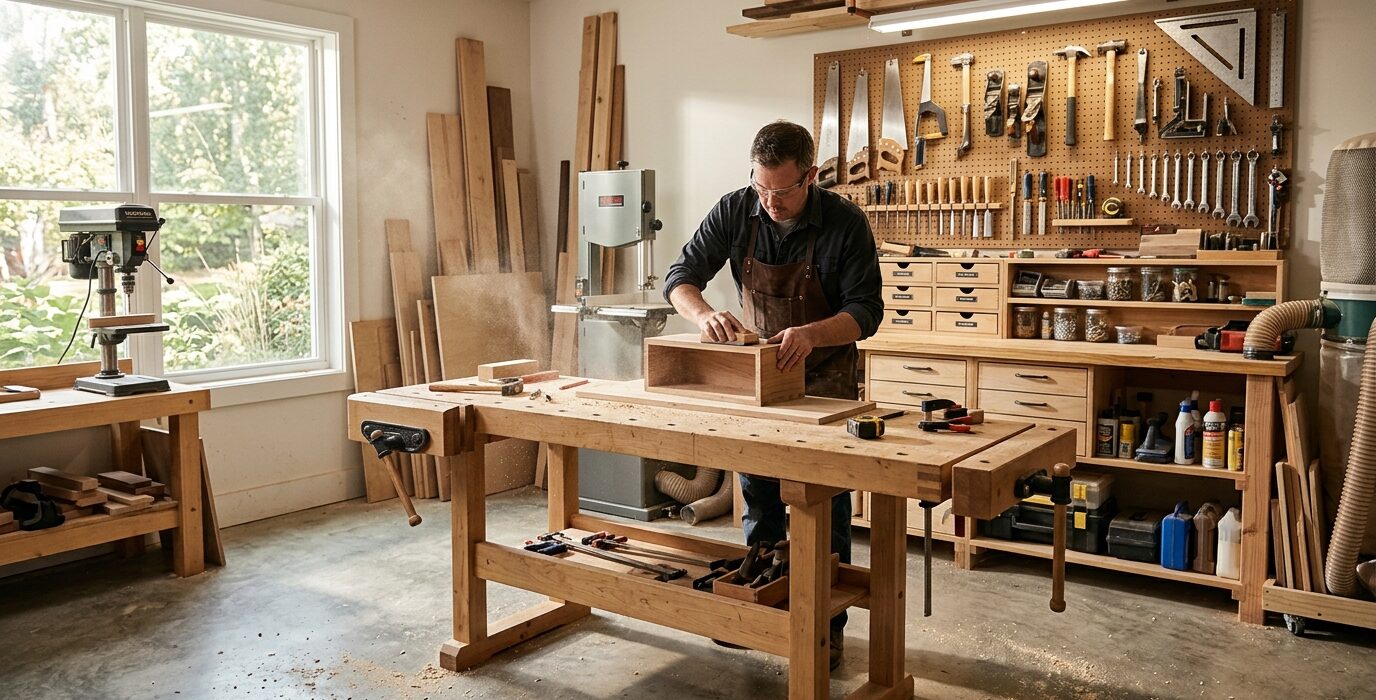
A Professional Cabinet Maker’s Home Shop
This tour covers the home shop of a retired cabinetmaker who spent 30 years in commercial production. His home shop is built to professional standards but sized for one person doing one project at a time. It’s not the biggest shop we’ve featured, but it’s the most disciplined – every decision made from experience, not enthusiasm.
Philosophy: Production Quality, Hobby Scale
Commercial cabinet shops are designed for throughput: one operator feeds sheets into a panel saw, another handles edge banding, a third assembles. The home shop handles all these operations sequentially, by one person. The machine selection, jig inventory, and organization reflect this – everything is calibrated for solo operation and immediate repeatability.
The Machine Selection
- Powermatic 66 table saw (10-inch, 3 HP) – not the newest machine but the most reliable one available
- Powermatic PM-15 15-inch planer with dual heads – used weekly
- Jet 6-inch jointer – adequate for home shop work but would upgrade to 8-inch given the choice again
- Powermatic 14-inch band saw for curved work and resawing small stock
- Festool domino joiner – the most valuable single purchase in 10 years of home shop work
- Festool track saw for sheet goods – replaced a panel saw he’d had for 20 years
The Jig Library
A retired cabinetmaker has a jig for everything. A dedicated jig cabinet holds 30+ shop-made jigs organized by machine. The box joint jig, the dovetail jig, the drawer-fitting jig, the mortising jig – all built over decades and labeled carefully. The jig library is one of the most valuable assets in the shop, representing years of problem-solving condensed into reusable solutions.
What’s Different From a Hobbyist Shop
Measurement discipline. Every machine in this shop is calibrated to within 0.001 inch – not because furniture requires that precision, but because the habit of precision makes everything more consistent. The fence is checked before every ripping session. The miter saw is tested with a four-cut test at the start of any session involving miters. Setup time is not resented – it’s understood as the prerequisite for accurate work.
FAQ
What’s the most important professional habit for home woodworkers to adopt?
Check your setup before trusting it. A contractor who’s been cutting miters all day doesn’t wonder if the saw is still accurate at 45 degrees – he cuts a test piece and measures. This habit – never assuming the last setting is still correct – eliminates the most common source of woodworking errors in any shop, home or commercial.