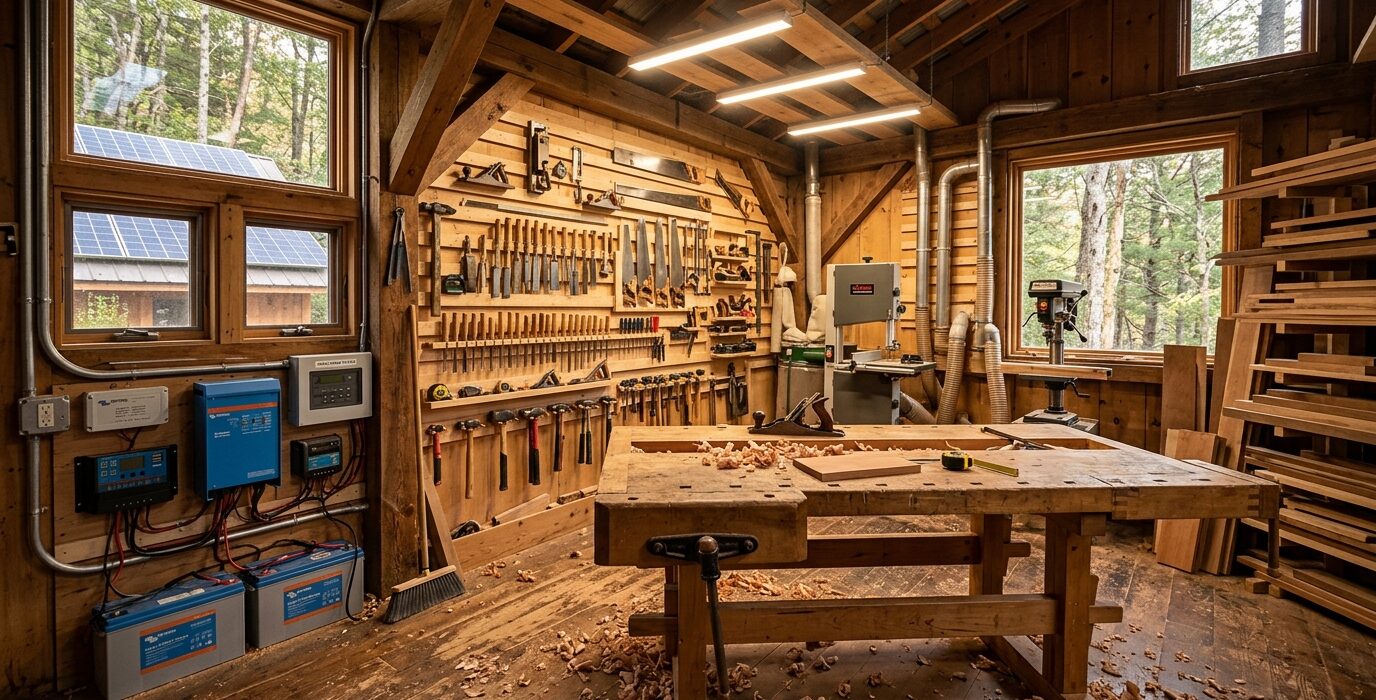
No Grid, No Gas, No Problem
The off-grid shop is powered by a combination of solar panels, a battery bank, and a small generator for high-draw operations. The location – a rural property 3 miles from the nearest utility connection – made grid power impractical. What started as a limitation became the driving design principle of the entire shop. Every tool choice, every workflow decision, every storage system was made with power consumption in mind. The result is a shop that runs entirely on solar most of the year.
Power System
Eight 400-watt solar panels on a south-facing roof feed a 48V battery bank with roughly 20 kilowatt-hours of usable capacity. An inverter converts DC battery power to 120/240V AC. On a good solar day, the shop runs indefinitely on panels alone. On cloudy winter days, a 7,000-watt propane generator supplements the batteries for high-draw operations like the table saw and planer.
Tool Selection for Low Power Draw
This shop runs no machine that draws more than 1,800 watts at startup – except the table saw, which runs for short bursts with the generator. The band saw is the primary ripping tool because it draws 700 watts, compared to 1,800 for a table saw. The drill press is a low-draw model. The dust collector is a shop vacuum rather than a 3-horsepower blower. Hand tools do the rest – and in this shop, hand tools do more work than power tools, which keeps energy consumption minimal during most sessions.
Lighting
All lighting is LED. The overhead shop lights total about 200 watts for the entire building – less than a single incandescent bulb per fixture location. Natural light from four south-facing windows provides daytime illumination that requires no supplementation except in the dead of winter.
Key Lessons
- The band saw as primary ripping tool changed how this woodworker thinks about cutting. Band saw cuts waste less wood (narrower kerf) and require less power. The tradeoff is a rougher cut face, handled with a hand plane or pass through the planer.
- Low-power constraints pushed this shop toward more hand tool use, which improved the quality of the work. It’s hard to rush with hand tools.
- The generator is non-negotiable for the table saw. Trying to run a table saw on an undersized inverter produces brownouts that damage the motor over time.
FAQ
How much does an off-grid shop power system cost?
A basic system – 2,000 watts of panels, a 10 kWh battery bank, and an inverter – runs $3,000 to $8,000 depending on battery chemistry and components. DIY installation reduces cost significantly, but electrical work on 48V battery banks should be done by someone who understands the risks.
Can I run a full woodworking shop off solar?
Yes, with planning. The key is knowing your peak draw – usually the table saw or planer – and sizing the battery and generator backup for that peak. Steady-state operations like lighting and dust collection are easy; high-draw motor starts are the challenge.